


How to Evaluate a PP Woven Cloth Tubing Machine for Woven Sacks: Capacity, Seaming, and Line Balancing
2026-10-21
A PP woven cloth tubing machine takes printed, laminated flat fabric and forms it into a flat or side-gusset tube in roll — on our FD-TG 60, across a tube width of 300–650 mm and a gusset depth of 25–152 mm at speeds to 100 m/min. A forming unit that stops short of your widest bag format caps your product range for the life of the machine. Check both ranges against the formats you expect to quote for, and settle the four questions below with your supplier before you sign.

The FD-TG 60 tubing line, rated to 100 m/min across a tube width of 300–650 mm.
Why the Flat-Web Route Needs a Tubing Station
The flat-web route exists for one reason: full-coverage print. Woven cloth carrying a picture-like image has to be printed and laminated while it is still flat, so the tube is formed afterwards — and that is the station our FD-TG 60 occupies.

Full-coverage print on a laminated woven sack — what the flat-web route produces.
We build it for woven cloth with overall printing, and for biaxially oriented polypropylene (BOPP) film that has been reverse-printed and then laminated to the fabric. Inside the machine the flat web runs through forming, gusseting, back-seam pasting and rewinding in sequence, leaving as a tube in roll ready for cutting and sewing.
The full route runs from flat yarn extrusion through weaving, printing, lamination, tubing, and cutting and sewing.
Not every sack needs it. If your output is standard one- or two-color bulk packaging — coarse salt, straight fertilizer, sacks where the print is a logo and a weight marking — direct printing on circular-woven fabric covers the job, and a tubing line is capital you do not need to spend.
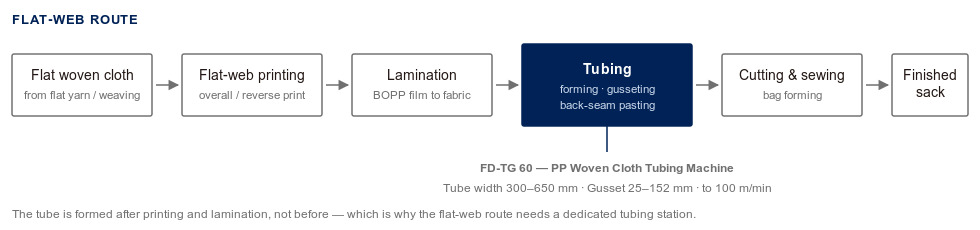
The tube is formed after printing and lamination, not before. That sequence is what makes a dedicated tubing station necessary.
Once the route is settled the question becomes throughput, and that is where the published speeds need reading carefully.
Line Balancing: Reading Printing Speed Against Tubing Speed
Tubing does not automatically become your bottleneck. Our FD-TG 60 produces to 100 m/min, and whether that constrains the line depends on which press sits upstream — because maximum machine speed and actual printing speed are not the same figure.
| Press | Max. machine speed | Printing, single side | Printing, double side |
|---|---|---|---|
| 4–6 color, single stack | 120 m/min | 60–100 m/min | 50–80 m/min |
| 6–12 color, two stacks | 180 m/min | 80–150 m/min | 70–130 m/min |
| 8–12 color, 900W series | 250 m/min | 180–230 m/min | 70–230 m/min |
Against a 4–6 color line the tubing stage is not a constraint at all. Against the 900W series it clearly is. Read your own case off the printing-speed column rather than the headline machine speed, which is a mechanical maximum rather than a production figure — the same distinction that decides which flexo press suits a plant.
Where a gap does exist, the unwinder accepts rolls to 1270 mm diameter, and that is what makes buffering practical: printed and laminated web is wound out to full roll diameter, held, and fed to the tubing machine on its own schedule instead of forcing the press to throttle down. How many running hours a full roll represents depends on your fabric weight and core diameter, so run that figure on your own material — or send us the layout and we will run it with you.
That assumes the tube itself comes off correctly, which comes down to two mechanisms inside the machine.
Inside the Machine: Back Seam and Gusset Forming
Two mechanisms decide what comes off the rewinder — the extruder that pastes the back seam, and the forming unit that sets tube geometry.
Back-seam pasting. A compact extruder with a 45 mm screw bonds the overlapped edge by melting material onto the seam as the web runs. The unit sits alongside the main frame with its own hopper and heated barrel, and the melt reaches the web at the point where the two edges overlap.

The compact extruder, with a 45 mm screw feeding the seam.

Melt leaving the die head. The same material is laid onto the overlapped edge to form the back seam.
Forming geometry. The forming unit produces either a flat tube or a side-gusset tube from the same single-ply web, with tube width adjustable across 300–650 mm and gusset depth across 25–152 mm. Switching between flat and gusseted output is a setting, not a different machine.

Printed web entering the former. Tube width and gusset depth are both set at this unit.
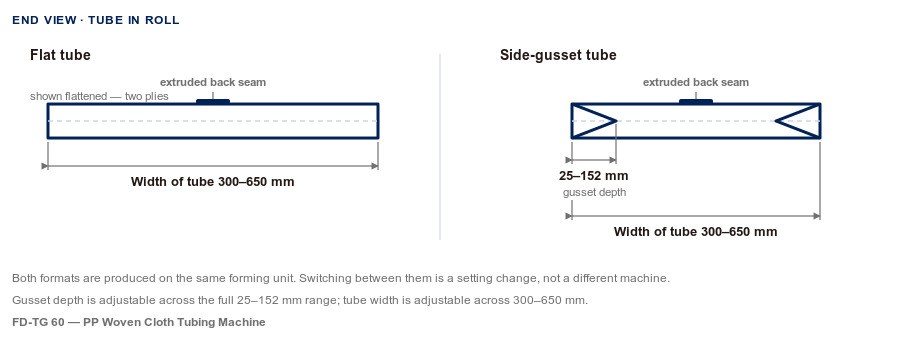
Flat and gusseted output from the same forming unit — 300–650 mm tube width, 25–152 mm gusset depth.
Web handling and control. An automatic roller changer holds constant fabric tension through the run, and automatic position rectification keeps the web square so the roll winds evenly. Temperature, line count and machine functions are grouped on a single control cabinet.

Temperature control, line counter and touchscreen on one panel. Ask which zones map to which part of the seaming process.

The gusset as it appears in the finished sack. Fold symmetry set at the forming unit carries all the way through to filling.
For a component-level walkthrough of the printing stage that feeds this one, see The Technology Behind Roll to Roll Flexographic Printing.
Those are the mechanisms. How they behave against your own materials and order pattern is what you have to establish before ordering.
Four Things to Confirm Before You Order
Four points fall outside what any specification table can answer, ours included. Put them to every supplier you shortlist.
- Film compatibility. Whether the seam bonds reliably against matte BOPP or metallized laminate, not only standard gloss film. Send us your film structure and we will answer it directly.
- Cooling scope. Which cooling hardware is standard, and at what production conditions the optional cooling blower set becomes necessary.
- Hot-melt material and temperature control. Which resin grades the extruder is set up for, and how the temperature zones are configured.
- Changeover time. How long a width or gusset-depth change takes in practice, and whether it is an adjustment or a parts change.
| FD-TG 60 | Specification |
|---|---|
| No. of ply | One layer |
| Type of tube | Flat or gusset tube |
| Width of tube | 300–650 mm |
| Width of gusset | 25–152 mm |
| Max. speed of production | 100 M/Min |
| Max. dia. of unwinder | 1270 mm |
| Screw diameter | ∮45 mm |
Common Questions
Two questions come up more than any others when buyers first scope this stage.
Can the machine produce plain flat tube without gussets?
Yes. The forming unit runs both flat and gusseted output, and tube width is adjustable across the full 300–650 mm range in either mode.
What lamination equipment normally sits upstream?
A flat-web double-side lamination line, which laminates the printed cloth before it reaches the tubing machine.
Talk to Us With Your Bag Format in Hand
Fabric and film behave differently at the seam. Weave weight, coating structure and film type all shift the working temperature and the speed you will actually hold, and no published figure covers every combination.
The tubing station is one of several we build for this route — flat yarn extrusion, weaving, printing, lamination, tubing, and cutting and sewing all come from the same plant.
Send us the bag format you are planning — tube width and gusset depth — along with the material structure of your printed web, and our engineering team will come back with a machine configuration and a realistic throughput figure for that spec.
Already running a tubing line and moving to a new bag format, or changing gusset depth on existing tooling? Same contact.