


How to Choose High-Speed Roll-to-Roll Flexo Printing Machines for PP Woven Bags (8–12 Color Selection Guide)
2026-09-03
High-speed roll-to-roll flexo printing for polypropylene (PP) woven bags requires a drying configuration capable of matching line speeds up to 250 m/min without ink smearing or registration loss. While central impression (CI) flexo presses specialize in thin film stretch control, stack-type flexo printing machines with multi-deck drying ovens provide superior dual-sided direct printing and lower operational maintenance for coated and uncoated tubular woven fabric. Buyers who specify printing lines without evaluating web tension dynamics or solvent evaporation rates often face ink blocking during rewinding or costly speed throttles. The rest of this article explains how to evaluate stack-type roll-to-roll flexo presses for industrial sack production.
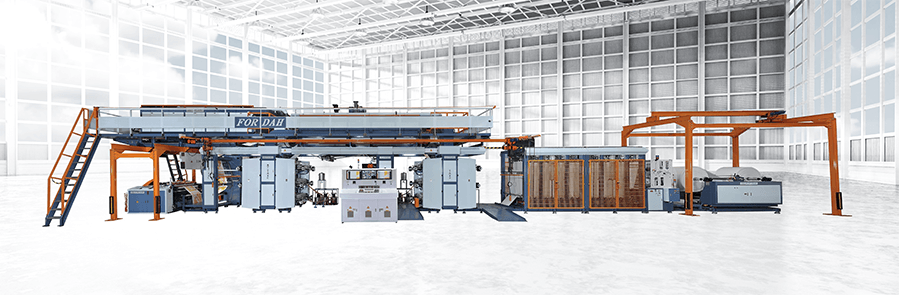
The 900W (250M) roll-to-roll line: two vertical printing stacks flanking a four-deck drying section, rated to 250 m/min on a 950 mm web.
Stack-Type vs. Central Impression (CI) Flexo Printers for Woven Sacks
Production of PP woven sacks breaks down into two distinct printing requirements, and press architecture determines both initial capital expenditure and daily operating flexibility. Central Impression (CI) flexo presses lock the substrate against a single large impression cylinder, making them ideal for ultra-thin, highly extensible polyolefin films. However, tubular PP woven fabric—whether uncoated or coated with Polyethylene (PE)—possesses high tensile rigidity and dimensional stability compared to unstretched film.
Stack-type flexo printing machines arrange individual color decks vertically in one or two stacks (such as 4+4, 5+5, or 6+6 configurations). This arrangement allows direct printing on both sides of a tubular web in a single pass.
Stack Flexo vs. CI Flexo Comparison
| Evaluation Criteria | Stack-Type Flexo | Central Impression (CI) |
|---|---|---|
| Two-Sided Direct Print | Single-pass (4+4) | Requires turnbars |
| Mechanical Complexity | Lower / Modular | High (central drum) |
| Changeover & Maintenance | Fast & accessible | Specialized service |
| Web Width Accommodation | Up to 950+ mm | Fixed drum envelope |
If your throughput target sits below 250 m/min, the same stack architecture is available on the 180 m/min and 120 m/min single-stack lines at lower capital cost.
For woven bags require multi-color branding on both front and back side (such as fertilizer, animal feed, and cement sacks), stack-type presses deliver higher throughput at significantly lower maintenance costs.
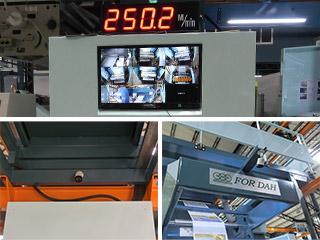
Line speed verified on the machine: the readout holds 250.2 m/min while the four-channel still-image system lets the operator check color-to-color registration without stopping the press.
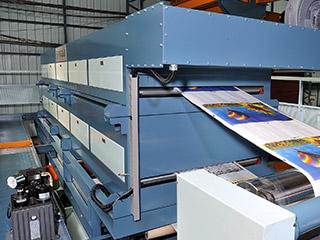
Full-color printed woven web leaving the 3rd and 4th drying decks — removing residual alcohol and ester solvents here is what prevents ink blocking in the rewound roll.
Preventing Ink Smearing at 250 M/Min: The Role of 4 Drying Ovens & Web Guiding
Running solvent-based flexographic inks on woven fabric at line speeds up to 250 m/min requires rapid, controlled solvent flash-off between printing stations and prior to final rewinding. Solvent retention in rewound rolls causes blocking—a defect where printed ink transfers onto the adjacent fabric layer under winding pressure.
To maintain print clarity at high speed, modern high-speed lines incorporate a four-deck drying oven system. Before examining how drying decks function, review the critical parameters that govern high-speed solvent evaporation:
- Independent Thermal Deck Control: Dedicated heating elements and blowers positioned after intermediate decks ensure quick-drying between color printing.
- Final Drying Tunnel: A high-capacity 3rd and 4th stage drying tunnel removes residual alcohol and ester solvents before the printed web reaches the out-feed nip.
Synchronizing servo-driven out-feed devices with automatic tension controllers stabilizes the web tension profile, eliminating mechanical distortion on woven meshes.
The clip below shows a 900W-series line running direct print on tubular woven fabric at production speed — the web passing the intermediate decks, through the final drying tunnel, and into the out-feed nip.
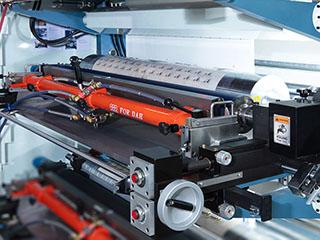
Chambered doctor blade with a ceramic-coated anilox roller. The enclosed chamber removes manual ink-fountain adjustment and cuts solvent loss from the ink pan.
Turret-style automatic roller changing rewinder. Non-stop roll changes hold constant line speed, so drying conditions never shift mid-order.
8-Color (4+4) vs. 12-Color (6+6) Flexo Configurations: Which Do You Need?
Selecting color deck capability depends on package graphic complexity, spot color branding requirements, and halftone photo-realism goals.
Standard 8-color flexo presses (configured as 4+4 for dual-sided printing) accommodate classic Cyan, Magenta, Yellow, and Key/Black (CMYK) process printing on the front side, plus four dedicated spot colors or solid background coats on the back side. This configuration satisfies over 80% of agricultural and chemical woven sack applications.
Flexo Color Configuration Guide
| Model Series | Color Deck Layout | Typical Application |
|---|---|---|
| 908-90W (8-Color) | 4 Front / 4 Back | Standard CMYK + Spot Colors |
| 910-90W (10-Color) | 5 Front / 5 Back | Standard CMYK + Spot Colors |
| 912-90W (12-Color) | 6 Front / 6 Back | Standard CMYK + Spot Colors |
Critical Equipment Components for High-Precision Printing
Achieving photo-like graphics on woven fabric demands precision metering of low-viscosity solvent inks. Anilox Rollers engraved at 200 to 300 Lines Per Inch (LPI) deliver consistent volumetric ink transfer to the rubber or photopolymer printing plates.
Key component technologies to verify during equipment evaluation include:
- Chambered Doctor Blade Systems: Enclosed ink chambers with ceramic-coated rollers eliminate manual ink fountain adjustment and reduce solvent evaporation in the pan.
- Digital Camera Monitoring: High-speed video inspection systems capture still print images at 250 m/min, allowing operators to verify color-to-color registration without stopping the machine.
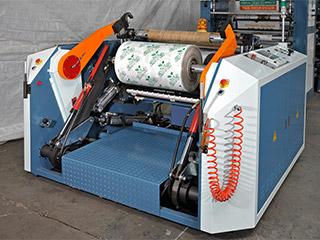
- Auto Roller Changing Rewinders: Non-stop turret-style roll changing systems allow continuous web splicing, maintaining constant line speed and reducing waste during fabric roll changes.
For a component-by-component walkthrough of how these presses work, see The Technology Behind Roll to Roll Flexographic Printing. Fordah also supplies the upstream and downstream stations of a complete PP woven bag production line, from flat yarn extrusion through cutting and sewing.
Summary & Checklist Before Ordering a Roll-to-Roll Flexo Press
Investing in a roll-to-roll flexo press requires aligning mechanical speed with real drying and registration capabilities. Before finalizing machine specifications, verify that your supplier provides:
- Proven drying capacity matching your target solvent formulation and line speed (250 m/min max).
- Dual-sided printing capability matching your product portfolio (4+4, 5+5, or 6+6 stack layout).
- Integrated web guiding and tension control at both feed-in and out-feed stations.
- Enclosed chamber doctor blade options for fine-line anilox metering.
To explore tailored machine configurations, review the full 900W (250M) specification. To explore tailored machine configurations for your woven bag production line, consult the engineering team at Fordah.